Candy Clark (Debbie) endorses Kip's American Graffiti Blog

ATTENTION: This blog works best in website mode (click below) KIP PULLMAN'S AMERICAN GRAFFITI BLOG is the best and most successful web tribute to the 1973 film classic, AMERICAN GRAFFITI. Here you'll find hundreds of original, accurate and well-researched articles by this author on American Graffiti including personal interviews, car information, film analysis, original newspaper clippings and other articles written by me.
Tuesday, December 19, 2023


Monday, January 16, 2023
Mel’s Drive-In Celebrates 75 Years

The Mel's Drive-In at 2165 Lombard St., San Francisco, opened in 1985
Last month, in the middle of December, Mels celebrated its 75-year anniversary by offering 75% off classic menu items. Owner, Steven Weiss notified me about the sale, but unfortunately, I did not get this posted in time for readers to benefit. Oops. Sorry. However, the least I could do was remind folks to be sure to visit a Mels Drive-in next time you’re in the area.
As long-time blog readers know, Mel Weiss and Harold Dobbs first established Mel’s Drive-in in 1947 and seventy-five years later, it still exists, with four locations in San Francisco and four in Southern California. It is still in the Weiss family, now operated by Colton Weiss; his brother, Chasen Weiss; his father, Steven Weiss; and Gabriel Mendez.
Besides being featured in the classic 1973 nostalgic film, “American Graffiti," Mel's Drive-In was featured in a Snoop Dogg music video and a Pepsi commercial with Doja Cat that aired during the 2021 Super Bowl. Mel's also counts celebrities Al Pacino, Adam Sandler, Paul McCartney, Wiz Khalifa, Andrew Wiggins and Guy Fieri as fans.
________________________
Wednesday, August 3, 2022
REMEMBERING BO

It's been a year now since the world lost actor, Bo Hopkins. Sadly, he died of a heart attack last May 28, 2022 in Van Nuys, California. Born in Southern Carolina in 1938, Bo began his career by acting in theater and then transitioned to television in the 1960s He garnered guest spots on such classic as The Andy Griffith Show, Bonanza and The Wild Wild West. He made his first feature film when he was 30 years old in the Sam Peckinpah landmark western, The Wild Bunch (1969) thus began an illustrious movie career with roles in over one hundred movies and thousands of TV appearances.
.jpg) |
Bo looking badass in Midnight Express (1978) |
Bo had thousands of roles but Kip's American Graffiti Blog readers will best remember the sandy-haired actor as, Joe "The Pharoah" [purposely misspelt]. His gift for believability is on full display as he subtly inhabits the role of the gang/car club leader in a small town in 1962. He is both intimidating and comical throughout. In one, now legendary, scene, his character attempts to persuade Richard Dreyfuss into vandalizing a local patrol car;
Look at it this way: Now you got three choices. One, you chicken out. In that case, I let Ants tie you to the car and drag you around a little bit. And you don't want that, right? Two, you foul up and Holstein hears you and well, ah... you don't want that, right? Three, you are successful and you join the Pharoahs with a carcoat, and the blood initiation and all that, huh?

Bo as Joe, the leader of The Pharaohs with Beau Gentry & Richard Dreyfuss
I first met Bo at the Petaluma Celebrates American Graffiti event in California along with some other actors in the film, Candy Clark (who played Debbie,) Manuel Padilla, Jr (Carlos) and Paul Le Mat (John Milner). All the nervousness I had about meeting the actor vanished as his friendliness, and good-ol'-boy charm captivated me. I asked him specifically about the early years of his movie career specifically the year 1972 when he worked on both American Graffiti and White Lightning starring Burt Reynolds. In the film Bo played a side-kick to Reynold's macho moonshiner. Speaking in his Southern drawl he recalled, "It was the beginning of Summer and right after I had filmed all my scenes with Richard Dreyfuss in Graffiti I immediately had to fly out to Arkansas and join the production of White Lightening. I had been working at night on Graffiti and had gotten used to that and suddenly I'm working in the bright daylight squinting my eyes and Burt would yell at me [laughs]. It was fun and kind of crazy!"
I also asked Bo whether he knew at the time, Graffiti would become the classic that it is today. [By the way readers, I absolutely hate when interviewers ask that question but I asked it anyway.] He replied in a warm matter-of-fact tone, "Shit, I thought just the opposite. I was just sure Burt's film would be a hit. Turns out nobody remembers it. "But," he added, "That little ol' low-budget film directed by some guy named, Lucas turned out to be a winner and folks like you are still talking to me about to this day!"
.jpg) |
Bo, Billingsley & Burt in WHITE LIGHTNING (1973)Bo couldn't have been more right about American Graffiti. It became a box office smash, grossing over $115 million worldwide. In 1974 the film won a Golden Globe for Best Comedy or Musical. It was nominated for several Academy Awards including Best Picture, Best Screenplay, Best Director, Best Supporting Actress (Candy Clark) and Best Film Editing. It also won several several Best Picture awards at well established events including New York Film Critics Circle Awards and the Kansas City Film Critics Circle Awards. Of course, that's to say nothing of the accolades the film continues to receive from film fans and classic cars enthusiasts to this day. But I digress... |

Bo & Farrah Faucett on the set of CHARLIES ANGELS (1976)
In February 2001 I saw Bo at a classic car show on the Cal Expo state fairgrounds in Sacramento, California. The yellow,1932 Ford coupe featured in Graffiti was on display. Hopkins was sitting at a collapsible table alongside actors, Candy Clark and Paul Le Mat. They were surrounded with fans who waited in line to have them sign photos and various Graffiti memorabilia. I too waited in line, this time to have him sign a picture of Wolfman Jack and himself at the premiere of Graffiti. I was also going to video tape an interview with him and later that day I did but unfortunately, it was erased when I accidentally taped over it to interview his Graffiti co-stars, Candy Clark and Paul Le Mat (which you can find on You Tube).
When I reached the front of the line, much to my delight, Bo looked up and recognizing me he momentarily slipped into his Joe The Pharaoh character exclaiming, "Whadaya doin', creep?" I played along and countered with Dreyfuss's response, "Me?" To which he replied, "No, I'm talking to the other fifty creeps here." He then gave me an sly grin. I was star-struck and a little nervous and not sure if I should continue responding with lines from the script, A script that I had memorized since I was 12 years-old, no less. However, I quickly realized why I was there and asked if I could record an interview with him later to post on my website. He agreed.

One of several photos that Bo signed for this writer
I don't remember our entire conversation verbatim that day, eleven years ago, but I took notes obviously. I must not have seemed like a total “creep” because he asked me to "watch his table" while he took a break outside. I obliged. I remember how important I felt as I sat there in Bo's chair thinking, "Hey everybody look at me, I'm friends with film actor, Bo Hopkins!" When Bo finally returned we chatted some more. We chatted about fishing and some of his favorite authors. He also claimed to be pretty good at painting with watercolors. "Well, my mamma thought my paintings were pretty good," he quipped. It was a wonderful interaction. I still have a 8x10 photo he signed for me. The inscription on the photo reads, simply, "To Mark, Thanks, Bo Hopkins." And now as I wrap this up I have to say, Thank you Bo Hopkins. Thank you for bringing happiness to myself and so many people out there, whether you were on screen or off.
 |
| A signed pic of Bo as Joe The Pharaoh that hangs on my wall |
Bored as Hell and Nothing to Rebel Against!
(Above) Ben Mankiewicz with Bo, Candy Clark & Paul Le Mat discussing "American Graffiti" at a 2014, Hollywood Roosevelt Hotel poolside screening

Bo & American Graffiti co-star/friend, Candy Clark Photo: Stephanie Keenan
~Fini~
____________________________________________
Notes:
- Bo Hopkins of American Graffiti - Interview at 2019 Portland Roadster Show. https://www.youtube.com/c/RidesDoneRight
- BO HOPKINS - UNINHIBITED, COLORFUL & HONEST. Industry Central. BSIMON. https://www.industrycentral.net/features/working_actors/bo_hopkins
- IN-PERSON CONVERSATIONS WITH BO HOPKINS. Mark Groesbeck. Various dates. 2009-2011.
Friday, April 19, 2019
SHOOTING AMERICAN GRAFFITI

“Sup Dawg? This time, we gonna drop it when it’s hot!” Oh, wow, how do I segue from mid-'90's rap blasting in my ear buds to 1950's rock and roll? I guess I'll pull up some early Elvis on Spotify. Maybe a little, "Mystery Train" or "Let's Play House." Okay, now I'm in the mood.
For this entry, in "Kip’s American Graffiti Blog,” we present
to you (because you never asked), notes on the shooting schedule of American Graffiti.
These notes include details about the actors, locations, technicians, and vehicles related to the production of the film. It represents a timeline which states where
and when production resources are used and the general filming locations. The information presented here is reproduced from
the daily progress reports as they are printed in the book, “The Cinema
of George Lucas” by Marcus Hearn. Additional comments by me, Kip. Also, I've included butt-loads of cool pics for fans to drool over.
So, lets set down the Gin & Juice and pick up a bottle of Old Harper & Coke and get into the spirit of things. Keep reading!
_________________________________________________
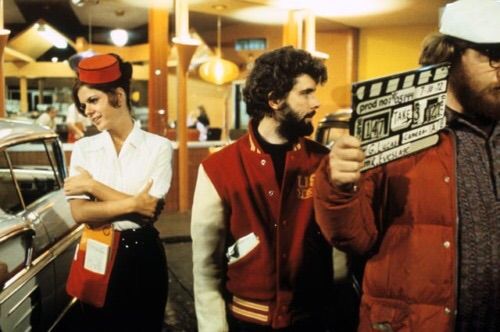 |
| Jana Bellan as carhop waitress, Budda looking cold with arms crossed. She, Lucas and staff prepare to shoot take 3 in which Budda turns down Toad for a date |
SHOOT DAY 1: Monday, June 26, 1972
CALL 7:00pm WRAP:
5:30am
LOCATION: 4th
St (Between C st. and Lincoln) San Rafael, CA
Scenes: EXT
STREET & COUPE (John and Carol) Scene Sc. 22 (John “I don’t like that surfing crap.
Rock –n-roll’s been going downhill since Buddy Holly died”)
Pages 2-6/8
Setups: 10
Pages 2-6/8
Setups: 10
SHOOT DAY 2:
Tuesday, June 27, 1972
CALL 8:00pm WRAP:
6:40am
LOCATION: 4th
St (Between C. and Lincoln) San Rafael, CA
Scenes: EXT
STREET & COUPE (John & Carol).
[John: “How old are you?” Carol: “Old enough. How old are you?” “Too old for you,”]
Pages: 4-7/8
Set Ups: 19
NOTES: Unable to clear
or control street as planned due to City Council Order to San Rafael Police
Department
 |
| A 45rpm record used for American Graffiti radio spots |
CALL 7:30 WRAP:
5:40am
LOCATION:
Oakhill Park & Petaluma Blvd., Petaluma Blvd., Petaluma, CA.
Scenes: EXT STREET (Coupe/Water Balloon/Park)
Pages: 3:
-2/8
Setups: 29
Cars: ’32 Coupe,
Studebaker, 24 atmosphere cars

SHOOT Day 4:
Thursday, June 29, 1972
CALL 7:30pm WRAP:
5:30am
LOCATION:
Petaluma Streets, Petaluma
Scenes: EXT
STREET & COUPE (Coupe & Falfa).
Scene 54 [Carol] Carol: "He’s fast” John: “Yeah, 'but he’s stupid.”
Pages 2-7/8
Setups: 28
 |
| Mackenzie Phillips and Pau Le Mat rehearse their lines as Lucas (red jacket in window) watches. |
SHOOT Day 5:
Friday, June 30, 1972
CALL 6:30pm WRAP:
5:40am
LOCATION:
Rusty’s Auto Wrecking, 21481 8th St East, Sonoma, CA; Scene
30 (song indicated [“It’s just a matter of time”]
Pages 3-7/8
Setups: 23
Livestock: 1 dog
 |
| Paul Le Mat "John Milner" |
SHOOT Day 6: Monday July 3, 1972
CALL 7:30pm WRAP:
5:40am
LOCATION: 4th
Street San Rafael
Scenes: EXT STREET
(Coupe/BA/Bozo, etc) Scene 24 [Traveling-Terry-Mercury”: song indicated: "Almost
Grown”] Sc 27 [Driver-Mercury: “Toad is that you in that beautiful car?" Terry nods casually. “Jeeze what a waste of
machinery.”]
Pages: 4
Setups: 16
HOLIDAY: July
4, 1972
No work
No work

The cast & crew ate meals at the old Mayflower Van & Storage location in Petaluma where cars and filming equipment were stored during the daytime. (Photo courtesy of Candy Clark)
SHOOT DAY 7: Wednesday July 5
CALL: 7:30pm WRAP:
5:30am
Location: Wilson’s Appliance Store, 145 Kentucky Ave.,
Petaluma; Chamber of Commerce Parking Lot, Petaluma Blvd.
Scenes: EXT TV APPLIANCE STORE. Sc. 36 [Curt is
shanghaied by the Pharaohs]
EXT. PARKING LOT
EXT. STREET
PAGES: 6
SETUPS: 13
 |
| The talented, Bo Hopkins as "Joe the Pharaoh" |
SHOOT DAY 8 Thursday, July 6
CALL: 7:30pm WRAP: 5:45am
LOCATION: Richmond
Streets, Richmond CA; Miniature Golf Course/Office, Pinole
SCENES: EXT STREET (Hoods/Curt/Merc)
EXT. Miniature Golf Course
INT. HOLE-IN-ONE OFFICE Sc. 48 [Joe: “We’re outta
gas.” Curt: “They don’t sell gas here”
“We’re outta money too.”]
PAGES: 6-1/8
SETUPS: 16

SHOOT DAY 9:
Friday, July 7
CALL: 7:30pm WRAP:
5:15
LOCATION: Chamber of Commerce
Lot, Petaluma Blvd. North
SCENES: EXT
PARKING LOT, Sc. 62 [the patrol car loses its trans-axle and two rear wheels.]
PAGES:
1-7/8
SETUPS: 26

SHOOT DAY 10:
Monday, July 10
CALL: 7:00pm WRAP: 6:00am
LOCATION: Mels
Drive-in,140 S. Van Ness near Mission San Francisco, CA
SCENES: EXT.
DRIVE IN, Sc 2 [“A large neon sign buzzes in the foreground, “Burger City,”
while in the background, Rock Around the Clock” blares from the radio of a
beautiful decked and channeled candy-apple red, tuck and rolled ’53 Merc that
glides into the Drive-in.”]
PAGES: 4
SETUPS: 15
CARS: Citroen
SR EQUIPMENT: (1)
Jeep Crane #4
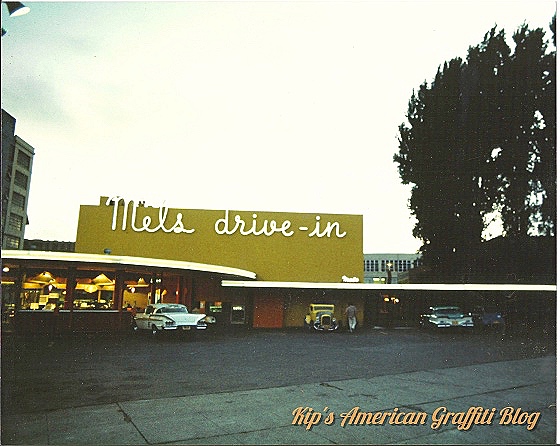
In this rare photo you can glimpse one of the tall San Francisco buildings next to Mels that director, Lucas tried to avoid capturing on film.
SHOOTING DAY 11: Tuesday, July 11
CALL: 7:00pm WRAP: 6:00am
LOCATION: Mels Drive-in, San Francisco
Scenes EXT DRIVE-IN, Sc. 42 [John orders Carol a Coke; Song designated: In the Still of the Night.”]
PAGES 8
SETUPS: 23
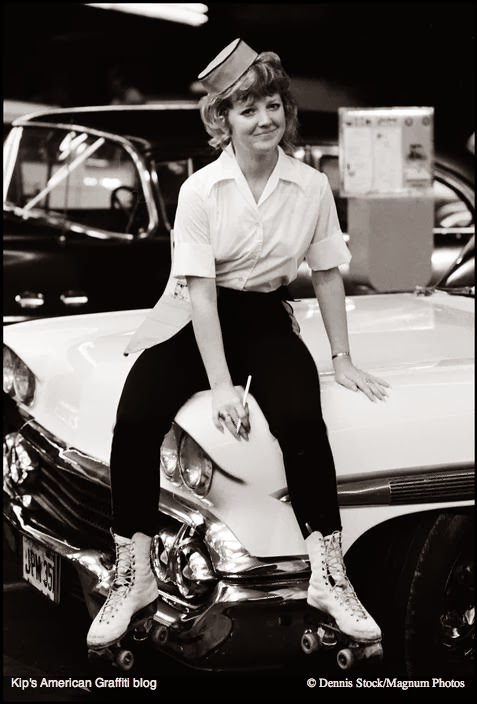 |
| Background actor, Donna Wehr sits on the now famous 1958 Impala. |
SHOOT DAY: 12 Wednesday, July 12
CALL: 6:30pm WRAP: 5:30am
LOCATION: Mel’s Drive-in, San Francisco
Scenes EXT. DRIVE-IN, Sc72
Pages 5-2/8
SETUPS: 24
 |
| Filming Ron Howard in an interior scene at Mels Drive-in. Lucas (under counter), Haskel Wexler (behind camera) |
SHOOT DAY 13: Thursday, July 13
CALL: 7:30pm WRAP: 5:30am
LOCATION: C of C. Lot, Petaluma. Petaluma Streets
SCENES: EXT. STREET
EXT. CAR LOT & STREET
EXT. CAR LOT/COPS (retake)
PAGES: 1-2/8
SETUPS: 20

George Lucas directs future directors, Ron Howard & Charles Martin Smith
SHOOT DAY 14: Friday July 14
CALL: 6:30pm WRAP: 5:26am
LOCATION: Marin Memorial Cemetery, Novato
SCENES: EXT CANAL. [Laurie gets angry with Steve;
The Merc is stolen; talk of the “Goat Killer”
PAGES: 4-2/8
SETUPS: 8

SHOOT DAY 15: Monday, July 17
CALL: 6:00am WRAP: 7:49
LOCATION: Mel’s Drive-in, San Francisco
Scenes INT. DRIVE-IN
EXT. DRIVE-IN, Sc [Curt speaking on the phone to the blonde in the white T-bird: “It’s important to me.. You’re the most perfect beautiful creature I’ve ever seen and I don’t know anything about. Could we meet someplace?” Voice: “I cruise 3rd Street every Night. Maybe I’ll see you again tonight.” “I don’t think So…I’m leaving in a couple of hours.”
PAGES: BAL OF SEQ
SETUPS: 30
Notes: (1) Éclair camera fell off tripod-badly damaged

Director George Lucas poses with Richard Dreyfuss (sitting in a Citroen 2CV)
SHOOT DAY 16: Tuesday July 18
CALL: 6:30pm WRAP: 5:26am
LOCATION: Marin, Memorial Cemetery, Novato;& Petaluma Streets, Petaluma
SCENES EXT. STREET (Terry/Falfa)
SCENES EXT. STREET (Laurie/Falfa)
PAGES: 2-4/8
SETUPS: 12
NOTES: Light rain from 1:30am to wrap prevented completion of scheduled scenes, streets too wet.
 |
| Ed Greenberg "Kip Pullman." |
SHOOT DAY: 17 Wednesday July 19
CALL: 7:30 WRAP: 5:37
LOCATION: Petaluma Streets (Petaluma Blvd.,Kentucky, Washington, Western)
SCENES EXT. STREET (Curt/V.W./T-Bird/Kip) Sc. 29
[Shouting from on e car to another, Kip: “Henderson, Long time no see. What’cha been doing?” Curt: “Not much, just wanted to let you know that Bobbie here is hopelessly in love with you and trembles at the sight of your rippling biceps…” Bobbie turns in the V.W. and “starts flailing at Curt with her purse.”]
PAGES: 1-2/8
SETUPS: 20
SHOOT DAY 18: Thursday July 20
CALL: 7:30 WRAP: 5:45
LOCATION Rowena Lane (KTOB transmitter), Petaluma, Lazy-Me Used Cars, 320 Petaluma Blvd.; North Petaluma streets.
SCENES EXT. RADIO STATION, Sc. 70 [Manager: “The Wolfman is everywhere…Listen-no offense to your hometown here, but this ain’t exactly the hub of the universe…Hell, here I sit while there’s a whole big beautiful world out there.”]
EXT CAR LOT
EXT. STREETS
PAGES: 2
SETUPS: 18
 |
| KTOB radio tower site located on Rovina Ln. was Petaluma's local community radio station for many decades. The exterior scenes of Curt approaching Wolfman's radio station, XERB were filmed here. |
Friday 7-21-72 - Company DID NOT WORK
SHOOT DAY 19: Saturday, July 22
CALL: 12:00pm WRAP: 8:45pm
LOCATION: Marin Memorial, Cemetery, Novato
SCENES EXT. CANAL & CANAL ROAD, FILTER DAY FOR-NIGHT
PAGES: 4-1/8
SETUPS: 11

Filming a cruising montage on 4th Street in San Rafael, CA
SHOOT
DAY
20: Sunday, July 23
CALL: 7:30 WRAP: 5:40
LOCATION: 4th St., San Rafael
SCENES EXT. STREETS-MONTAGE SEQUENCES
PAGES: 2
SETUPS: 27
Note: 4 cameras used…one Jeep crane
SHOOT DAY 21: Monday, July 24
CALL: 8:30pm WRAP: 6:30am
LOCATION: Sanders Used Cars (B St. and Petaluma Blvd North); EZ Pickins Gas Station,
U.S. 101 (South of Petaluma); Frates Road, Sonoma County
SCENES EXT. CAR LOT
EXT STREETS
EXT. GAS STA., Sc 66 [Attendant (to John): “Why do they even try…Hell; you’ve been number one longer than I can remember…”]
EXT PARADISE ROAD, Sc 75 [“Both cars roar off the starting line, tires smoking and screaming.”]
PAGES: 2-4/8
SETUPS: 23
SHOOT DAY 22: Tuesday, July 25
CALL: 8:30pm WRAP: 6:40pm
LOCATION: Petaluma High School; Pet Streets; Frates Road.
SCENES EXT. GYM PARKING LOT, sc 21 [Wendy: “Same old Curt. All the time we were going together you never knew what you were doing.”]
EXT STREETS
EXT. PARADISE ROAD (cont’d)
PAGES: 2-2/8
SETUPS: 22
NOTE: Blew reverse gear in ’32 Coupe
SHOOT DAY 23: Wednesday, July 26
CALL: 8:30pm WRAP: 6:30am
LOCATION: Rear of Beasley’s Rest. (Petaluma Blvd. N. &Washington); Pet. Streets, Frates Road
SCENES EXT. BAR PARKING LOT
EXT. STREETS (Curt/T-Bird)
EXT. PARADISE ROAD (cont’d)
PAGES: 4
SETUPS: 26
NOTE: 1st attempt to roll car failed…approx. 6:10 Am. Continued to shoot until wrap. Car unable to repeat run due to broken tie rod.
SHOOT DAY 24: Thursday, July 27
CALL: 8:30pm WRAP: 6:40am
LOCATION: EZ Pickins, U.S. 101; Public Parking
Lot, Petaluma Blvd.; Streets and sidewalk, Petaluma Frates Road
SCENES EXT. GAS STATION (pick-up c.u. “John”)
EXT ACME LOT
EXT. STREET and SIDEWALK
EXT. PARADISE ROAD (cont’d)
PAGES: 3-3/8
SETUPS: 25
NOTE: 2nd attempt at car stunt failed…Bent right tie rod.

SHOOT DAY 25: Monday, July 31
CALL: 8:00am WRAP: 8:00pm
LOCATION: Petaluma High School, Marin Memorial Cemetery, Novato
SCENES INT. HALL
INT. BOY’S LAVATORY
INT. GIRL’S LAVATORY
EXT. CANAL AND CANAL ROAD (retake)
PAGES: 1-5/8
SETUPS: 13
NOTE: Retakes needed at Canal location due to underexposed film.
CALL: 7:30 WRAP: 5:40
LOCATION: 4th St., San Rafael
SCENES EXT. STREETS-MONTAGE SEQUENCES
PAGES: 2
SETUPS: 27
Note: 4 cameras used…one Jeep crane
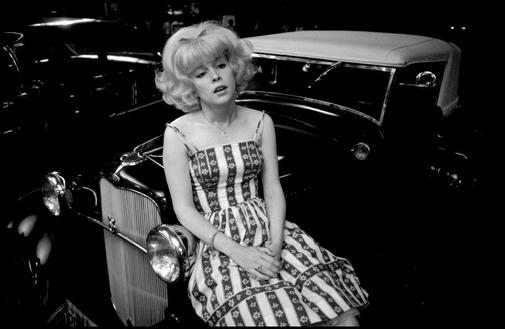 |
| Candy Clark "Debbie" rests between takes on the hood of a car. (Photo: Dennis Stock/Magnum Photos) |
SHOOT DAY 21: Monday, July 24
CALL: 8:30pm WRAP: 6:30am
LOCATION: Sanders Used Cars (B St. and Petaluma Blvd North); EZ Pickins Gas Station,
U.S. 101 (South of Petaluma); Frates Road, Sonoma County
SCENES EXT. CAR LOT
EXT STREETS
EXT. GAS STA., Sc 66 [Attendant (to John): “Why do they even try…Hell; you’ve been number one longer than I can remember…”]
EXT PARADISE ROAD, Sc 75 [“Both cars roar off the starting line, tires smoking and screaming.”]
PAGES: 2-4/8
SETUPS: 23
 |
| Climactic drag race on Frates Road "Paradise Road" in Petaluma, CA |
SHOOT DAY 22: Tuesday, July 25
CALL: 8:30pm WRAP: 6:40pm
LOCATION: Petaluma High School; Pet Streets; Frates Road.
SCENES EXT. GYM PARKING LOT, sc 21 [Wendy: “Same old Curt. All the time we were going together you never knew what you were doing.”]
EXT STREETS
EXT. PARADISE ROAD (cont’d)
PAGES: 2-2/8
SETUPS: 22
NOTE: Blew reverse gear in ’32 Coupe
 |
| 100 block Petaluma Blvd. North (circa 1986) Sonoma Co. Library |
SHOOT DAY 23: Wednesday, July 26
CALL: 8:30pm WRAP: 6:30am
LOCATION: Rear of Beasley’s Rest. (Petaluma Blvd. N. &Washington); Pet. Streets, Frates Road
SCENES EXT. BAR PARKING LOT
EXT. STREETS (Curt/T-Bird)
EXT. PARADISE ROAD (cont’d)
PAGES: 4
SETUPS: 26
NOTE: 1st attempt to roll car failed…approx. 6:10 Am. Continued to shoot until wrap. Car unable to repeat run due to broken tie rod.
 |
| Beasley's Eats' (circa 1975) rear parking area located on Water Street, Petaluma. The beige car in the background is the location where Toad (Charles Martin Smith) got sick, beat up and rescued by John Milner (Paul Le Mat). |
SHOOT DAY 24: Thursday, July 27
CALL: 8:30pm WRAP: 6:40am
LOCATION: EZ Pickins, U.S. 101; Public Parking
Lot, Petaluma Blvd.; Streets and sidewalk, Petaluma Frates Road
SCENES EXT. GAS STATION (pick-up c.u. “John”)
EXT ACME LOT
EXT. STREET and SIDEWALK
EXT. PARADISE ROAD (cont’d)
PAGES: 3-3/8
SETUPS: 25
NOTE: 2nd attempt at car stunt failed…Bent right tie rod.
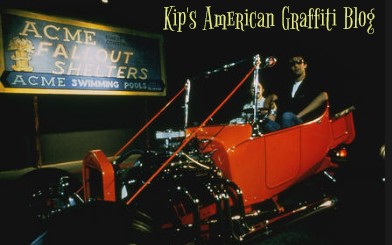
SHOOT DAY 25: Monday, July 31
CALL: 8:00am WRAP: 8:00pm
LOCATION: Petaluma High School, Marin Memorial Cemetery, Novato
SCENES INT. HALL
INT. BOY’S LAVATORY
INT. GIRL’S LAVATORY
EXT. CANAL AND CANAL ROAD (retake)
PAGES: 1-5/8
SETUPS: 13
NOTE: Retakes needed at Canal location due to underexposed film.
 |
| Candy Clark & Charles Martin Smith's make-out scene was filmed in daylight at a tributary of the Petaluma River located near the base of the first hill immediately north of the Novato airport. |
SHOOT DAY 26: Tuesday, Aug 1
CALL: 10:00am WRAP: 10:10pm
LOCATION: Mt. Tamalpias High School- Boy’s Gym, Mill Valley
SCENES INT. GYM (Sock Hop), Sc. 14 [designated song: “At the Hop”]
PAGES: 6-1/8
SETUPS: 38
NOTE: 4 cameras used

SHOOT DAY 27: Wednesday, August 2
CALL: 8:30pm WRAP: 6:15am
LOCATION: Petaluma High School; Petaluma Streets
SCENES EXT. GYM PARKING LOT
EXT. STREETS
EXT. DRIVE-IN (retake)
PAGES: 2-7/8
SETUPS: 18

Executive Producer, Francis Ford Coppola visits Lucas on location at the Tamalpais High School boy's gym in Marin, CA

Richard Dreyfuss attempts to relax a nervous Wolfman Jack by goofing around between takes
SHOOT
DAY 28: Thursday, August
3
CALL: 8:30pm WRAP: 6:40am
LOCATION: KRE Radio, Berkeley; Buchanan Field, Concord
SCENES EXT./INT. RADIO STATION
EXT: AIRPORT
INT. AIRPLANE
PAGES: 4-2/8
SETUPS: 16
NOTE: Airplane unable to taxi off due to flat left tires. Did not get shot of plane airborne.

SHOOT DAY 29: Friday, August 4
CALL: 8:30pm WRAP: 9:30am
LOCATION: 884 Bodega Ave., Petaluma; Frates Road;. Buchanan Field (2nd unit)
SCENES EXT. /INT LIQUOR STORE, Sc. 44 [Toad tries to buy the elusive bottle of “Old Harper. Designated song:Teenager in Love”]
EXT. PARADISE ROAD (retake)
EXT. AIRPORT/AIRPLANE, SC. 79 [“Curt listens to the radio as the plane takes off. As it climbs and banks out over the valley, the music fades and the station drifts between static and other stations an then it’s gone. Curt turns off the radio and looks out the window. As the plane banks, the wing tips down and through the window Curt sees the yellow Thunderbird crossing beneath on the small grey ribbon of highway. Curt leans up, watching it-the plane shadow ripples over the car and then it’s gone”]
PAGES: 4-1/8
SETUPS: 26
NOTES: Low overcast prevented shooting at Frates Road location until 8:40am. Stunt again failed to work. “A” arm and tie rods bent. (1) cameraman & (1) asst. cameraman to airport to film plane take off after company wrap at Frates Road location.
Wrap 1st unit shooting “AMERICAN GRAFFITI”

CALL: 8:30pm WRAP: 6:40am
LOCATION: KRE Radio, Berkeley; Buchanan Field, Concord
SCENES EXT./INT. RADIO STATION
EXT: AIRPORT
INT. AIRPLANE
PAGES: 4-2/8
SETUPS: 16
NOTE: Airplane unable to taxi off due to flat left tires. Did not get shot of plane airborne.
SHOOT DAY 29: Friday, August 4
CALL: 8:30pm WRAP: 9:30am
LOCATION: 884 Bodega Ave., Petaluma; Frates Road;. Buchanan Field (2nd unit)
SCENES EXT. /INT LIQUOR STORE, Sc. 44 [Toad tries to buy the elusive bottle of “Old Harper. Designated song:Teenager in Love”]
EXT. PARADISE ROAD (retake)
EXT. AIRPORT/AIRPLANE, SC. 79 [“Curt listens to the radio as the plane takes off. As it climbs and banks out over the valley, the music fades and the station drifts between static and other stations an then it’s gone. Curt turns off the radio and looks out the window. As the plane banks, the wing tips down and through the window Curt sees the yellow Thunderbird crossing beneath on the small grey ribbon of highway. Curt leans up, watching it-the plane shadow ripples over the car and then it’s gone”]
PAGES: 4-1/8
SETUPS: 26
NOTES: Low overcast prevented shooting at Frates Road location until 8:40am. Stunt again failed to work. “A” arm and tie rods bent. (1) cameraman & (1) asst. cameraman to airport to film plane take off after company wrap at Frates Road location.
Wrap 1st unit shooting “AMERICAN GRAFFITI”
A rare pic of the the aircraft used for the final scenes in Graffiti. The company which loaned the prop plane to Lucas and crew was named, Magic Carpet Air Travel Club
2 nd UNIT SHOOTING: Monday, 8/7/72
CALL: 4:00am WRAP: 10:42am
LOCATION: Frates Road
SCENES: EXT PARADISE ROAD (retake stunt and explosion only)
EXT. ROAD/T-BIRD (aerial shot)
NOTE: Used Cessna as camera plane f/aerial shot.
(4) cameras used on stunt.

NOTES:
CALL: 4:00am WRAP: 10:42am
LOCATION: Frates Road
SCENES: EXT PARADISE ROAD (retake stunt and explosion only)
EXT. ROAD/T-BIRD (aerial shot)
NOTE: Used Cessna as camera plane f/aerial shot.
(4) cameras used on stunt.
______________________________________________
NOTES:
- Eats 1975. Shorpy old Photos. Retrieved 4/20/19. https://www.shorpy.com/node/10973
- Hearn, Marcus. The cinema of George Lucas. p74-75. (2005) Published by Abrams, an imprint of Harry N. Abrams, Inc. New York, New York
- Shooting Schedule Law and Legal Definition. https://definitions.uslegal.com/s/shooting-schedule/
- Sonoma County Library [Histroric photos of Petaluma] https://sonomalibrary.org/locations/sonoma-county-history-and-genealogy-library
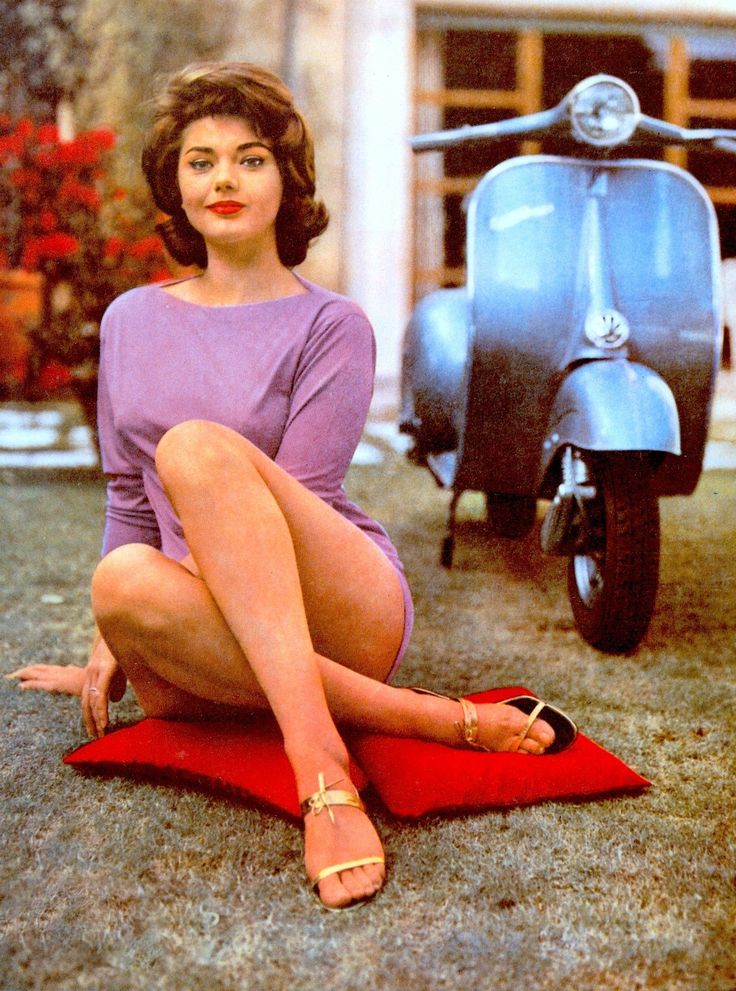 |
| Actress, Sylvia Koscina. 1962 |
Subscribe to:
Posts (Atom)